Saturday, August 11, 2012

stv0900-scan

Here is a simple spectrum analyzer app for the stv0900 devices in linux, works with my Prof 7500. Should work with others but send me a shout if your using another device and how it works out for you.


here is the link to the src as well as the kernel patch's required.

The stb6100 has a hardware limitation of a bandwidth minimum of 5mhz so you'll never get the same detail from a Prof as you would a device designed for use as a spectrum analyzer. As you can see compared to the blsa.

Wednesday, July 25, 2012

BLSA-Qt

Here is BLSA-Qt its pretty ruff right now, it does what it has to and thats it, the old blsa tool should still be used if you have to calibrate your blsa.

You'll need qtcreator, qt dev, and qwt installed to compile


Wow long time eh?

Been a long time since I posted anything, was away serving overseas for 11 months, then once I got back I felt it was important to really catch up on family time. Now after being on home soil for a few months I feel I can start taking some time for my hobbies again.

Here are some patch's for the Prof 7500 and TBS6925 in linux, they are to be patched against the TBS driver tree but it wouldnt take much to patch it against the linux-3.5 branch as they are very similar.

This patch will fix these issues

- Add crazycat's multistream option
- Prof 7500
- fix some speed up tuning issues
- make FE_GET_PROPERTY return the values used to lock, not what you told it to tune, but what it actually tuned.
- fix a minor issue where only some fec's were being returned when FE_GET_PROPERTY was called.
- TBS6925
- make FE_GET_PROPERTY return the values used to lock, not what you told it to tune, but what it actually tuned.

Monday, June 27, 2011

FunCube Dongle and OSX, ie fun with python

So gnuradio seems to have a bug with CoreAudio right now, I cant use any SR higher then 44100 without getting errors. The funcube dongle has a fixed rate of 96000, no other option. So hence I cant use gnuradio with it, and basically thats all I want my funcube dongle for.

So instead of learning coreaudio to fix the bug I figured it would be fun to learn a little more about python and how wav files work and how gnuradio stores and transmits data.

Here is a small app I wrote that takes data from the funcube dongle (in int 16bit 2ch) and converts it to a 32bit float for gnuradio. Now I dont know python that well but I couldnt for the life of me find a function that did this, so I had to learn how float's were stored in a bitwise fashion then write my own function. Its ugly and slow, actually too slow, so I had to write a small app to make a cross reference include file with an array of the values converting int16 to float32

But whatever, it works :) now I can use my funcube dongle in osx again.

Ive included the record_tcp app that creates a server for gnuradio to connect to

127.0.0.1:21644

and record_file that saves the output in both gnuradio .dat and .wav format

FunCube python interface.zip

Wednesday, April 20, 2011

Two Watson antenna's. The 881 and 889

Long story short I ordered the 881 and I thought Canada Post lost it so being in a hurry I ordered the 889, both arrived the same day lol. Oh well so to compare them :)

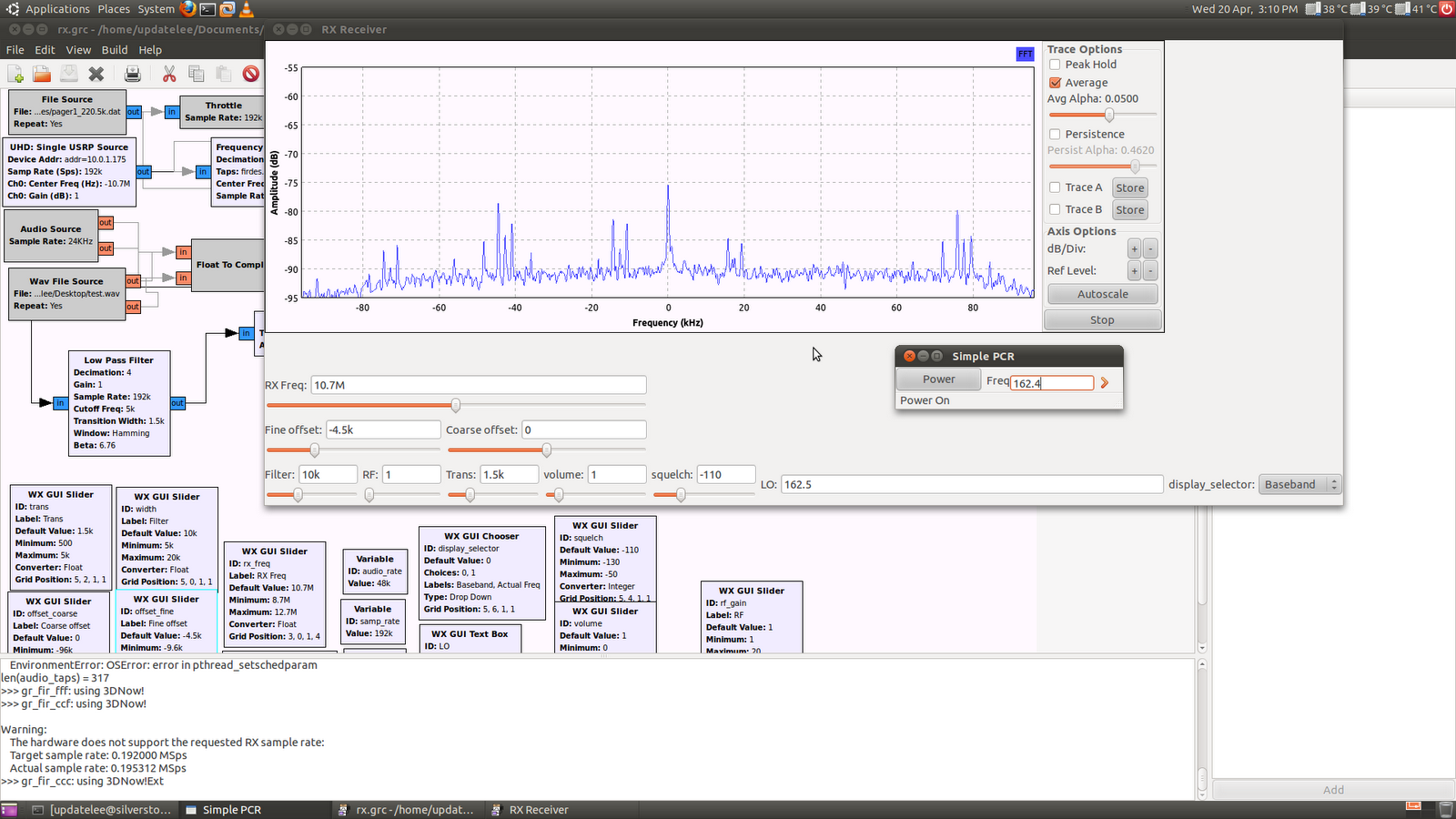
The WSMA881 on 162.4mhz

The WSMA881 on 867mhz


The WSMA889 on 162.4mhz, there really is no difference here between the two antenna's

The WSMA889 on 876mhz here really shines when you shorten the antenna, because its telescopic from 5.5"-16". When left at full length it was no better nor worse. Shortened a little and it really took off as the superior of the two.


All the tests were done in my concrete basement with the scanner on the desk about 1ft away from the wall surrounded by electronics gear, a terrible environment for radio lol. But that was kind of the point, I didnt want a perfect environment to test it in, Im never in such a place so why test in one haha.

I want to thank Durham Radio for their excellent sales service. It looked like the 881 was lost in the mail and they got a 889 out to me next day on UPS I was really thankful for them.

Sunday, February 13, 2011

Friday, February 11, 2011

The Arduino controlling a Von Weise actuator arm

Use PWM I can control the speed and direction of the arm using serial cmd's through the Arduino, this will let me have full remote control of my dish without the need for a satellite receiver

Here is a picture of the setup plus my bench.

Here is the sample src.

Im using an Arduino UNO Mega along with a DFRobots motor controller

The power supply is a 36v 10a ps bought off ebay, there are hundreds of them on there and they're cheap too.

The actuator is a Von Weise V76-5


edit: Well something went horribly wrong lol


Still not 100% sure what happened, was playing with python and py-serial to make a little Qt app for this and sparks and smoke everywhere

36v @ 10amps sure has some kick hehe